A star curve isn't proof of anything, but it is a signal: how to read OpenClaw's open-source adoption and what it changes about the way we think about AI agents.
Some images stop you in your tracks because they tell a story in two seconds.
A GitHub star curve is one of them.
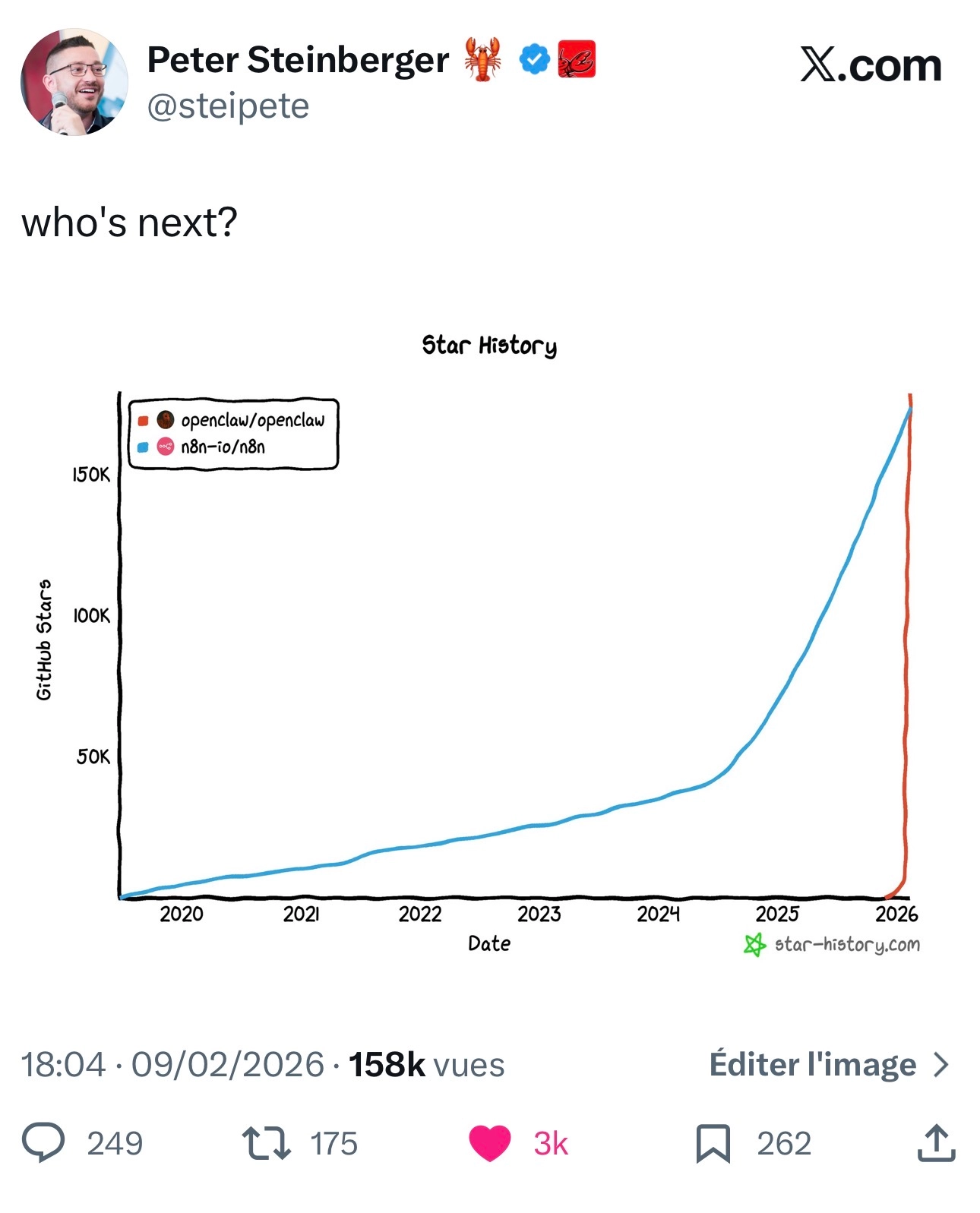
When you see a project accelerating very fast, you can react in two ways:
- "It's just hype."
- "Something is going on."
The truth usually sits between the two.
In this article, I want to offer a simple — and useful — reading of what this kind of curve can mean, using OpenClaw as an example. And, more importantly, why this "signal" matters if you build (or use) AI agents.
A star curve is not proof of quality. It is a signal of attention. Our job is to read it correctly.
The numbers that turn heads
OpenClaw shipped at the end of November 2025 under the name "Clawd," went through several renames, and eventually became OpenClaw on January 29, 2026.
In less than four months, the project posted numbers that are extremely rare for an open-source tool:
- 100,000 GitHub stars in less than 2 months
- 250,000 stars crossed in early March 2026
- 350,000 stars, 70,000 forks, 1,600 contributors in April 2026 (source: Star History)
- 2 million visitors on the website in a single week after launch
- 129 startups generated $283,000 in revenue in 30 days around the ecosystem
For comparison: it took major projects like n8n or Langchain years to reach these thresholds.
So yes, something is going on.
What the curve says — and what it doesn't
What it does say
Strong acceleration usually tells you:
- there is a clear need (real pain felt by many),
- the time-to-value is short (people quickly see what it's for),
- there is organic word-of-mouth (developers share with developers).
Put differently: the project found a place where it "resonates."
What it doesn't say
A curve does not prove:
- production-grade robustness,
- 12-month maintainability,
- the safety of real-world usage,
- the quality of docs or support.
And above all: a curve says nothing about your specific context. A tool can be excellent… and still useless to you.
The flip side of mass adoption: security researchers have identified more than 40,000 OpenClaw instances exposed on the internet. Fast adoption brings risky usage with it. That's not a reason to avoid the tool — it's a reason to configure it carefully.
Why open source can move so fast
When an open-source project addresses a real need, the speed comes from a simple loop:
- users try it,
- they report bugs and feature requests,
- maintainers iterate quickly,
- others contribute (PRs, docs, examples),
- trust grows → adoption goes up.
The loop gets even more powerful when the product is:
- easy to try (clean install, fast demo),
- easy to grasp (sharp positioning),
- easy to extend (plugins, scripts, integrations).
That's exactly why an open-source "explosion" can be a serious signal: not because "it's popular," but because a lot of people had a reason to look at it quickly.
The interesting signal behind OpenClaw: the agent as a system
What I find striking about OpenClaw is less "the model" itself and more the way the problem is framed.
Many AI tools still feel mentally like a "chat": one interface, one prompt, one answer.
OpenClaw pushes you toward a different reality: as soon as you hook an AI into your daily life (messages, tools, automations), what you're really building is a system.
A system means:
- a gateway to receive and send messages (Telegram, Slack, etc.),
- sessions (context, history, state),
- scheduling (tasks at fixed times),
- triggers (webhooks, for example),
- safety rules (who can talk to the bot, who can trigger what).
The shift: it's not "a smarter bot." It's "an assistant you steer," with rules, triggers and guardrails.
Why it matters (beyond the buzz)
Because it changes the question.
We no longer just ask: "Is the model good?"
We have to ask:
- Who is allowed to talk to it?
- When does it act automatically?
- Which tools can it use?
- How do we verify what it did?
- Where are the secrets and credentials stored?
In short: we're back to architecture and operations questions.
OpenClaw and n8n: not a duel, more of a combination
If you know n8n, you'll see the point: it's an excellent automation engine.
n8n is at its best when you can say:
- "When X happens, do Y"
- with well-defined steps,
- and reproducible execution.
That's valuable, because:
- it's debuggable,
- it's auditable,
- it's documentable.
OpenClaw, on the other hand, brings a different layer: an assistant that can make automation more accessible day to day.
A simple example
Instead of spending 30 minutes building a workflow for a one-off task, you can sometimes:
- ask in natural language,
- let the assistant pick the right tool,
- then, once it becomes recurring → "industrialize" it in n8n.
A solid strategy:
- OpenClaw to explore, orchestrate, steer
- n8n to harden and execute the things that need to be reliable
Where each one shines
- n8n: known, repetitive processes; need for traceability.
- OpenClaw: ambiguous tasks, unstructured inputs, decision-making, multi-channel coordination.
In real life, many teams end up using both.
How to read an adoption curve intelligently (mini-checklist)
If you want to avoid the "hype vs. cynicism" trap, here are 7 questions worth more than the star count:
- Can I try it quickly? (install, quickstart)
- Is the mental model clear? (what it's for, what it isn't)
- Is security taken seriously? (sane defaults, permissions)
- Does it integrate with my day-to-day? (channels, tools, scripts)
- Can I extend it without pain? (plugins, scripts, API)
- Are there concrete examples? (real use cases, not just promises)
- Can I roll back? (reversibility, data under control)
If you have decent answers to 4–5 of those, then yes — the star curve becomes an interesting signal.
Conclusion
Open source is powerful because it puts a community in motion.
When a curve takes off, it's neither a "magic sign" nor "useless noise": it's usually an invitation to look more closely.
In the case of OpenClaw, the takeaway (in my view) is a simple reminder: an AI agent is not just a model, it's a complete system (messaging, tools, scheduling, security).
So — what makes you say that an open-source project is "serious"?
References
- OpenClaw — official GitHub repo: github.com/openclaw/openclaw
- Wikipedia — OpenClaw article (March 2026 adoption data): en.wikipedia.org/wiki/OpenClaw
- GetPanto.ai — OpenClaw AI Platform Statistics 2026: getpanto.ai
- KDnuggets — OpenClaw Explained, 2026: kdnuggets.com
- n8n docs: docs.n8n.io